
Hot London Restaurant Openings 2025: Design-Led Dining Destinations Shaping the City
As the year draws to a close, VISUALISTA revisits the restaurant openings that shaped London’s dining scene in 2025. Defined by strong concepts and considered interiors, these are the spaces where design and dining move in step. Don’t miss these must-visit spots in 2026.
Noisy Oyster, Shoreditch
London’s Hippest New Seafood Bistro Was Crafted to Look Like a Construction Site.

Designed by Harry Nuriev of Crosby Studios, Noisy Oyster takes Shoreditch’s raw, industrial DNA and amplifies it into an immersive dining environment. Think scaffolding elements, exposed wires, matte chrome and ventilation ducts — a look that feels intentionally unfinished, almost theatrical, yet surprisingly inviting. Nuriev calls it “a work-in-progress aesthetic”, designed to make guests question where construction ends. The result is a space that feels both futuristic and grounded in the district’s urban grit.
The founders, hospitality duo Madina Kazhimova and Anna Dolgushina, are no strangers to daring concepts (they’re also behind Soho’s Firebird). Here, they set out to reinvent the seafood bistro. The menu by head chef Alfie Banhnan does exactly that — oysters arrive from Ireland’s west coast, scallop crudo is topped with raspberry and basil oil, and smoky octopus comes with a tomato kick. Playful cocktails (try the pepper margarita or frozen martini) keep the energy buzzing.
It’s not just the food that lingers. Noisy Oyster raises the question: is beauty found in polish, or in rawness? And in a city where many restaurants feel over-curated for Instagram, this bistro’s chaotic charm feels refreshingly authentic.
Location: 2, Nicholls Clarke Yard, London E1 6SH, Shoreditch
Vibe: Industrial-chic, raw, theatrical
Highlights: Design that challenges what a restaurant should look like
Canal, Westbourne Park
A Waterside Bistro with Industrial vibe and Terrace

Design studio A-nrd (the team behind Kol, Akara, and Kolae) has reimagined the former taxi HQ with a language of raw tactility and reflection. At its core sits a sculptural zinc-clad island bar, crowned with creamy live-edge stone — a social anchor that draws the room together. Materials repeat in other interior details: hammered zinc reappears in bespoke wine shelving, its textured surfaces catching light from the canal and blurring the boundary between inside and out. Craft is everywhere: bespoke tables and banquettes by Jason Posnot, sculptural pendants by Findere, and Foscarini wall lights that add quiet drama. Each gesture carries A-nrd’s unmistakable language — tactile, stripped back, and intentionally enduring.
Rather than masking the site’s industrial bones, the studio amplifies them: celebrating raw textures, embracing patina, and striking a dialogue between robustness and refinement. Inside, an open kitchen framed by a glazed timber canopy brings a sense of theatre in restraint — connecting guests to the art of cooking without overpowering the calm rhythm of the room.
Canal is designed to be both a local hangout and foodie destination. Its terrace — a rare West London Riviera moment — invites long lunches, while indoors the space feels contemporary but human, polished yet with a handcrafted edge.
Head chef Adrian Hernandez Farina delivers an all-day bistro menu built on top-notch produce. Highlights include: beef cheek, monk fish with tomatoes and caper, squid ink tagliolini with clams.
For years, West London’s Grand Union Canal lagged behind East London’s lively Regent’s Canal food scene. With Canal, that gap closes. The restaurant merges industrial-inspired design, craftsmanship, and modern bistro cooking into a concept that feels both rooted in place and refreshingly cosmopolitan.
Location: 11b Woodfield Road, Westbourne Park, W9 2BA
Vibe: Waterside, sunlit, unpolished yet refined
Highlights: Zinc-clad bar & terrace dining
Legado, Shoreditch
The Basque-Inspired Restaurant Bringing Rustic Soul to Shoreditch

East London’s dining scene has no shortage of bold openings, but Legado, the new restaurant from Michelin-starred chef Nieves Barragán Mohacho, stands out for how it weaves Spanish heritage into Shoreditch’s industrial fabric. Legado is both a tribute to her Basque roots and a statement of what modern Spanish dining can be in London.
Designed in collaboration with Applied Studio, the 60-seat space blends Iberian warmth with urban edge. Expect handmade tiles, rose-pink plaster walls, terracotta crockery, and wrought-iron detailing balanced against exposed brick and raw finishes. At the centre are two bespoke ovens — a wood-fired lamb oven and a charcoal Josper, crafted by heritage Spanish makers Jumaco & Maestro — anchoring the open kitchen as both visual spectacle and culinary functional.
Legado translates to “legacy,” and Barragán Mohacho embraces the name fully. This is not just a restaurant but a reflection of her travels, upbringing, and belief in whole-animal cooking. Her vision is rooted in authenticity and respect for tradition while encouraging invention — with interiors that celebrate imperfection and food that honours the parts of the animal often overlooked.
The menu moves beyond familiar Spanish staples. A trio of three-sip cocktails sets the tone — tomato, mushroom, or rhubarb-based — before diving into sharing dishes straight from the ovens. Wines are exclusively Spanish, with a special emphasis on sherry and vintage cava.
Legado highlights a broader hospitality trend: the move towards deeply personal, narrative-driven concepts. For designers and brands, it shows how storytelling — through raw materials, handcrafted detail, and heritage culinary techniques — can differentiate a project in a crowded London market.
Location: Yards, 1C Montacute, London E1 6HU
Vibe: rustic Iberian warmth meets Shoreditch grit
Highlights: bespoke Spanish ovens as both design statement and culinary core
Lupa, Highbury
Actor Theo James Brings Bold Italian Dining to Highbury

The White Lotus star Theo James has stepped into London’s hospitality scene with Lupa, a new Italian restaurant in the social heart of Highbury. Partnering with head chef Naz Hassan (formerly of Michelin-starred Pidgin), James sets out to create a neighbourhood spot where food, drink, and conversation reign supreme.
Lupa’s interiors lean towards understated chic — minimal lines, white-draped windows that soften the light and a subtle sense of privacy that makes the space feel both cinematic and comfortable. It’s not about theatrics here, but about letting the food and convivial atmosphere take centre stage. Ceramist Valentine Benoist has designed vases to sit atop each candlelit table, while lime-washed walls and terracotta tones reference the Roman theme.
Expect unapologetic Italian comfort food, from hand-rolled pasta to lamb cutlets and a dreamy apricot-stuffed porchetta. For dessert, enjoy homemade creations by pastry chef Alessandro Boscolo.
In a neighbourhood already rich with Italian talent (Trullo is just around the corner), Lupa makes its case by going bold. London diners, increasingly drawn to hearty, unfussy Italian dining thanks to the success of Brutto, will find much to love here. With a Hollywood name attached and a chef who knows how to deliver, Lupa looks less like risky business and more like a soon-to-be Highbury classic.
Location: Highbury, London
Vibe: Minimal, intimate, comfort-driven
Highlights: Opportunity to meet the star
Barbarella, Canary Wharf
Big Mamma’s 70s Glam Spectacle Lands in Canary Wharf

The latest opening from the flamboyant Big Mamma Group, Barbarella channels the retro-futuristic glamour of 1970s Italian cinema. Designed by Studio Kiki, the group’s in-house team, the restaurant is a maximalist playground where escapism takes centre stage. Think mirrored ceilings, emerald-green palms, burnt-orange walls and a chrome lounge, a reference to Jane Fonda’s Barbarella sci-fi movie.
Upstairs, a three-metre chandelier fans out like Farrah Fawcett’s hair, while a giant halo-lit bust of David presides over the bathrooms. The interiors are cinematic and surreal, part disco, part Cinecittà, and entirely designed to overwhelm.
The menu, led by chef Marco Rastelli, plays Big Mamma’s greatest hits: one-metre truffle-coated spaghettone, lobster linguine, daily-changing pizzas, and a Brunello list that’s the group’s most extensive yet. Oversized desserts, like the towering lemon meringue pie, and cocktails from the “naughtiest XL list” keep the party mood alive.
Like its sister spots Gloria and Jacuzzi, Barbarella isn’t chasing restraint or subtlety. It’s about boisterous group dining, Instagram spectacle and unashamed fun.
Location: Unit 3, YY London, 30 South Colonnade, Canary Wharf E14
Vibe: Retro-futuristic, flamboyant, cinematic
Highlights: A one-metre spaghettone built for spectacle
Moi, Soho
Underground Beats and Japanese Flavours Meet in Soho’s New Subterranean Dining Hideaway

Moi is one of Soho’s most exciting 2025 openings — a Japanese-inspired restaurant and listening bar tucked beneath Soho’s lively streets. With a design that blends authentic materials, moody lighting, and a touch of controlled chaos, it offers a dining experience that is as much about atmosphere as it is about food.
Created by architectural and design studio Yodezeen, Moi celebrates imperfection with tactile surfaces of exposed brick, textured plaster, and wood finishes. The interiors strike a balance between freedom and tranquillity, unpretentious yet soulful. A poured-concrete spiral staircase is the dramatic centrepiece, leading guests from the dining space into a darker, moodier listening room below. Here, the energy shifts: lounge-style seating and a custom sound system by Friendly Pressure transform the subterranean space into something between a restaurant and a club.
Moi is more than a restaurant; it’s an immersive social hub. Upstairs, guests gather at the bar or watch chefs at work over the wood-fired grill in the open kitchen. Downstairs, the rhythm takes over: vinyl takeovers, moody lighting, and Japanese-inspired plates designed to be shared. It’s a dual personality: dining upstairs, beats underground.
Helmed by head chef Nick Tannett (formerly of Evernight and Endo at the Rotunda) alongside GM Andy Cook, who spent five years in Japan, the menu draws on Japanese flavours with British ingredients. The drinks list is just as considered — biodynamic wines by the glass, alongside saké and shōchū — all designed to complement the bold flavours.
For Soho, Moi adds something different: a restaurant-listening room hybrid that connects design, dining, and culture. Its layered concept reflects hospitality’s move toward multi-sensory experiences — spaces that aren’t just about food, but about music, atmosphere, and storytelling.
Location: 84 or 86 Wardour Street, London, W1F 0TQM, Soho, London
Vibe: Subterranean, moody, immersive
Highlights: Concrete spiral staircase & custom vinyl-powered sound system
Town, Covent Garden
A Playful Space-Age Bistro with a Dash of 1970s Glamour

Designed by Samuel Hosker of North End Design, Town in Covent Garden brings together volcanic ceramic pillars, chrome accents, and saturated colour to create an interior that feels both futuristic and nostalgic. Inspired by the 1977 Apple logo, Verner Panton’s bold forms, and even Soviet train design, the result is “modern glamour” with a playful twist.
At the heart of the room is a glowing green volcanic-lava kitchen pass — the “stage of the theatre” — where chef Stevie Parle orchestrates the open kitchen like a live performance. Lightboxes with softened corners add a space-age glow, while lemon-yellow group tables and curved colorful volcanic stone details keep the mood buoyant and eccentric. Hosker describes the project as “a chance to have fun,” drawing on inspirations from British Brutalism to Marc Newson and Pierre Cardin. The effect is immersive and joyful: a restaurant that doesn’t take itself too seriously, but still delivers craft and refinement.
On the plate, Parle’s ingredient-first menu matches the interiors’ vibrancy. Expect bold British produce handled with flair, served in a space that moves seamlessly from bright, social daytime dining to a chic, club-like atmosphere in the evening. Town proves that colour, theatre, and design heritage can be powerful hospitality tools.
Location: Drury Lane, Covent Garden, London WC2B
Vibe: Playful, space-age, modern glamour
Highlights: Volcanic lava ceramic kitchen pass as the restaurant’s glowing centrepiece
Mareida, Fitzrovia
A Fitzrovia Opening that Distills Chile’s Diverse Landscapes Into a Multi-sensory Experience.
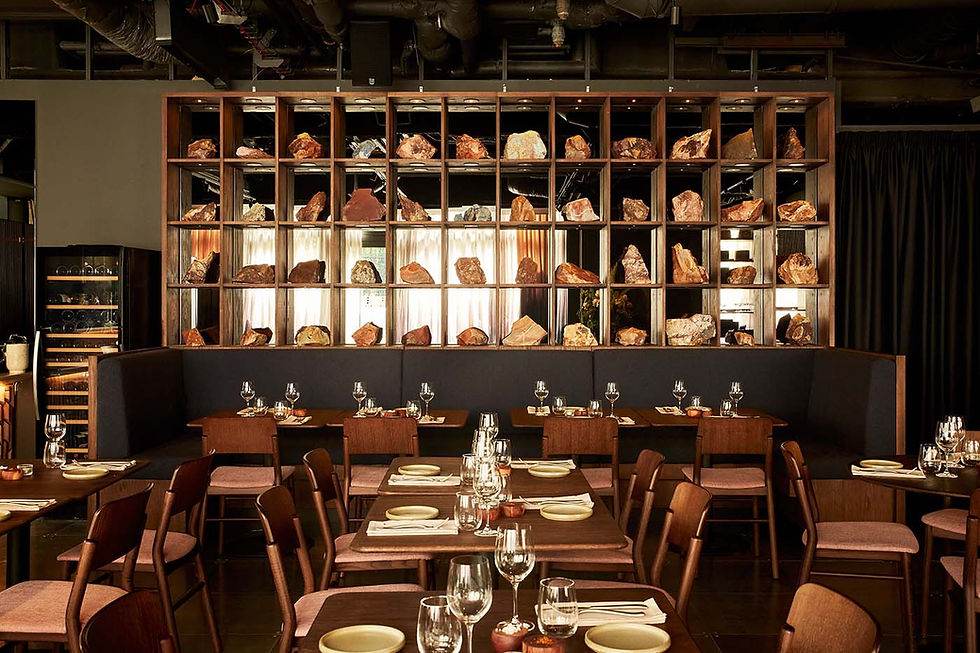
Founded by Prenay Agarwal, the restaurant is named after Amereida — a poetic journey across the Chilean landscape — and channels that spirit of exploration into both its menu and design.
Santiago-based architect Macarena Aguilar leads the interiors, grounding the space in natural textures and raw materials. A backlit wall decorated with uncut stone greets diners at the entrance, a striking homage to the Andes and its raw geography. In collaboration with architect Mále Uribe, custom tiles crafted from rare Combarbalita volcanic rock add a sculptural presence. Earthy, tonal palettes echo mountain ridges, while hand-dyed fabrics, linens and embroidered uniforms weave Chilean symbolism into every surface.
Head chef Trinidad Vial Della Maggiora, with Carolina Bazán, crafts a menu that bridges sea and land, tradition and innovation. Signature dishes include a rich crab cake and a beef tongue in walnut sauce — showcasing a cuisine still little-known in London but brimming with depth. A Chilean-led wine list by sommelier Rosario Onetto highlights small-batch producers.
The sensory journey extends beyond the plate — the sonic landscape, curated by London-based Chilean producer DJ Raff, layers Andean rhythms with ambient textures to immerse diners fully in Chile’s cultural identity.
Just as Peruvian food reshaped London dining a decade ago, Mareida sets the stage for Chilean cuisine to claim its place on the international map. With design, food, and music all working in harmony, it’s not just a restaurant but a cultural statement — an authentic narrative turned into a London hospitality experience.
Location: Great Portland Street, Fitzrovia, London W1
Vibe: Earthy, cultural, immersive
Highlights: Backlit Andes-inspired stone wall and menu rooted in Chilean heritage
Carbone, Mayfair
Italian-American Theatre, Served with Sinatra-Era Swagger

Carbone brings one of New York’s most iconic Italian-American restaurants to Mayfair, transporting its signature blend of nostalgia, drama and indulgence into a London setting. Designed by Ken Fulk, the interiors channel mid-century Manhattan glamour, drawing on the confidence of post-war supper clubs and Rat Pack-era dining.
The experience unfolds across two dramatic levels. At street level, signature blue panelling and marble mosaics set the tone before guests descend past a hand-painted mural into the main dining room. Here, ebonised mahogany marquetry, burgundy billiard-cloth ceilings, Campari-red velvet banquettes and red-and-white marble floors create a richly theatrical backdrop. Ciambella lighting and archival damasks by Watts 1874 heighten the sense of old-world opulence, while museum-grade artworks by Ai Weiwei, Julian Schnabel and Francesco Clemente add contemporary weight. Live music completes the supper-club atmosphere.
Service is deliberately performative. Waiters in custom burgundy tuxedos prepare Caesar salads tableside, while dishes such as Dover sole piccata and banana flambé are finished in front of guests. The menu focuses on Italian-American classics.
Location: The Chancery Rosewood, 30 Grosvenor Square, London W1K
Vibe: Glamorous, theatrical, old-school New York
Highlights: Tableside theatre set within one of London’s most extravagant dining rooms
Naya, Mayfair
Premium Patisserie with Heritage and Modern Glamour

Naya, a patisserie on North Audley Street, blends fourth-generation Turkish chocolatier heritage with refined London luxury. Founded by brothers Can and Cengizhan Ayan — descendants of the family behind legendary chocolatier Pelit — the bakery redefines indulgence, from chocolate éclairs to creamy Basque cheesecake, all plated with exhibition-like precision.
British designers India Hicks and Anna Goulandris led the interiors, creating a space that feels like an elegant drawing room. Hand-painted de Gournay wallpaper adds artistry and narrative to the walls. The wallpaper design draws inspiration from a lost treasure: the antique Chinoirerie that once adorned Baroness Pauline de Rotchild's Paris Apartment. Warm tones, soft fabrics, and a homely sitting-room atmosphere are elevated with glamorous touches — think leopard-print accents and a sculptural tree branching through the space, a theatrical anchor for the patisserie.
The menu layers nostalgia with modern taste. Sweet classics like strawberry mille-feuille sit alongside lobster rolls and bresaola sandwiches for those seeking a savoury bite. The experience extends beyond pastry — Naya offers a curated wine list, where champagne flows as easily as espresso.
Location: North Audley Street, Mayfair, London W1
Vibe: Luxe, heritage-rich, indulgent
Highlights: Hand-painted de Gournay walls and the theatrical tree anchoring the space
Nina, Marylebone
Italian Flavour with Milanese Edge in the Heart of Marylebone

Nina turns up the volume on Italian dining in London, proving that the city’s appetite for pasta and tiramisu is far from waning. Nestled on Thayer Street, this new opening from the Pachamama Group pairs sun-soaked Amalfi recipes with interiors that marry Milanese chic and industrial cool, creating a space that’s playful, stylish, and unapologetically bold.
A palette of soft beiges meets wabi-sabi-inspired raw brickwork and desaturated leopard-print wallpaper. Silver accents and curated artworks, chosen by project and art director Lunara Bramley-Fenton, complement the gleaming steel plates on which the dishes arrive. Warm wooden floors anchor the space, balancing the industrial elements and keeping the room grounded.
Under the guidance of executive chef Tzoulio Loulai and creative director Yaroslava Malkova, Nina offers a concise menu devoted to perfectly rendered Italian favourites. Every dish is deliberate: house focaccia with parmesan butter sets the tone, followed by bottarga linguine, cacio e pepe, and spaghetti al pomodoro. Mains are hearty and satisfying, while desserts — boozy tiramisu al cucchiaio and stracciatella burnt cheesecake — close the meal with a flourish.
Location: 18 Thayer Street, Marylebone, London W1U 3JY, UK
Vibe: Industrial-chic, Milanese flair, playful energy
Highlight: Edgy interiors paired with perfectly executed Italian classics
The Lavery, South Kensington
A Historic Artist’s Residence Reimagined for Dining

The Lavery is a new restaurant and event space set within a prominent Georgian terrace in South Kensington, named after its original artist-in-residence, Anglo-Irish painter John Lavery. Natural light is the star here. In the late 1880s, Lavery used the house’s sunlit studio to paint his portraits, and today those same generous windows continue to define the atmosphere.
Spread across the first-floor dining rooms, the Grade II-listed townhouse has been handled with restraint. Bright white interiors allow original features to shine: private staircases with curved timber handrails, ornate fireplaces, intricate cornicing, baroque mirrors and plasterwork that catches and reflects the light throughout the day. The house itself becomes the backdrop rather than the statement.
The interiors are overseen by creative director Martin Cohen, known for launching Rochelle Canteen, who has filled the rooms with carefully sourced furnishings drawn from Europe’s storied social spaces, including Venice’s Hotel Excelsior, London’s Groucho Club and La Chaux-de-Fonds in Switzerland. A contemporary zinc bar by Daytrip Studio (Oriole, Nightjar) anchors the experience, acting as a natural meeting point for lunch and dinner.
In the kitchen, head chef Yohei Furuhashi — formerly of the River Café and Toklas at 180 The Strand — brings a quietly confident approach, offering a seasonal Mediterranean menu.
Location: South Kensington, London
Vibe: Light-filled, elegant, quietly artistic
Highlights: Historic interiors where daylight does the decorating
This guide is curated by Visualista’s creative team, specialists in hospitality marketing and PR. We collaborate with interior designers, brand managers and creative directors to elevate dining performance and craft design-led restaurants that truly stand out.


Comments